
 Pусский
 中文
中文


-
Share:
Contact us
Inquiry
-
E-mail:info@xfjdmc.comWhatsApp:+8618871097635
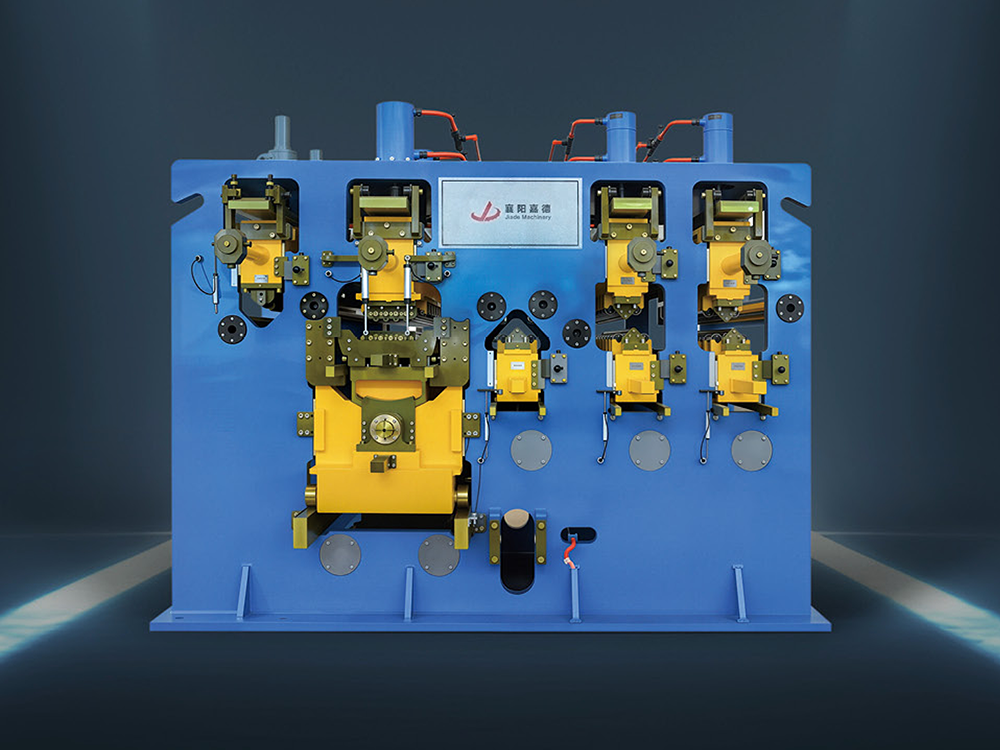
Tension leveler

There are two units in Jiade Tension Leveler
· "Bend" (B): A Bending Unit. These rolls force the strip to undergo elastic-plastic deformation (reverse bending) to eliminate internal stresses and stretch the material fibers.
· "Flat" / "Flatten" (F): A Flattening Unit. These rolls remove the residual curvature from the bending process, ensuring the strip exits flat and stress-free.
· Notation: Configurations are expressed as nB + mF (n bending units + m flattening units).
2. Detailed Explanation of Configurations
One-Bend-One-Flat (1B1F)
· Setup: 1 Bending Unit + 1 Flattening Unit.
· Process Flow: Bend → Flatten.
· Characteristics: This is the simplest and oldest configuration. It has limited ability to correct complex shape defects (like combined center buckle and edge wave) and is less effective for thicker gauges.
· Application: Mostly found in older, low-speed lines or applications with minimal flatness requirements. Rarely used in modern green field projects.

2️⃣ Two-Bend-One-Flat (2B1F) — The Economic Choice
· Setup: 2 Bending Units + 1 Flattening Unit.
· Process Flow: Bend → Bend → Flatten.
· Characteristics: The most common configuration globally. Double bending provides sufficient elongation to remove standard wave defects. However, with only one flattening unit, controlling severe transverse bow (crossbow) or camber can be challenging.
· Application: Pickling Lines (PL) and Standard Galvanizing Lines (CGL). Ideal for mild steel and medium flatness requirements.
3️⃣ Two-Bend-Two-Flat (2B2F) — The High-Performance Standard
· Setup: 2 Bending Units + 2 Flattening Units.
· Process Flow: Bend → Bend → Flatten ① → Flatten ②.
· Characteristics: The industry standard for high-quality products. The second flattening unit specifically targets residual transverse curvature and complex shape defects. It provides superior flatness and better stress distribution.
· Application: Continuous Annealing Lines (CAL), Automotive Grade Galvanizing Lines, and Advanced High-Strength Steel (AHSS) processing.
4️⃣ Three-Bend-Two-Flat (3B2F) — The Specialized Solution
· Setup: 3 Bending Units + 2 Flattening Units.
· Process Flow: Bend → Bend → Bend → Flatten ① → Flatten ②.
· Characteristics: The third bending unit allows the machine to achieve the required elongation at a lower strip tension. This is critical for materials prone to cracking (like Ultra-High Strength Steels) or very thick plates where tension capacity is limited. It offers maximum corrective power but is more expensive and complex.
· Application: Dedicated AHSS lines, Grain-Oriented Electrical Steel, or heavy gauge processing where tension limits are a concern.
3. Comparison Summary Table
| Configuration | Setup | Elongation & Flatness Capability | Equipment Cost | Typical Application |
|---|---|---|---|---|
| 1B1F | 1 Bend + 1 Flat | ★☆☆ (Basic) | Lowest | Old lines, Low-grade strips |
| 2B1F | 2 Bend + 1 Flat | ★★☆ (Good) | Medium | Pickling Lines, General Purpose |
| 2B2F | 2 Bend + 2 Flat | ★★★ (Excellent) | High | Automotive, High-Strength Steel |
| 3B2F | 3 Bend + 2 Flat | ★★★★ (Superior) | Highest | Ultra-HSS, Thick Plates, AHSS |
Key Takeaway
The choice depends on the product mix. If you process standard steel, 2B1F is cost-effective. If you process Automotive Exposed Quality or AHSS, 2B2F is the minimum requirement, while 3B2F is used for the most demanding materials to reduce the risk of strip breakage.

Tension Leveling is the process of pulling the strip beyond its yield point to permanently change the shape of the strip and make it flat. If you have an edge wave, the concept is to stretch the shorter fibers in the center of the strip so that they will match up in length with the longer fibers from the edge wave.
Conversely, if you have a full center, you are attempting to stretch the edges of the strip to match up in length with the center buckle. If the strip is consistent in length across the width of the strip, you have created flat steel. The tension leveling process is a combination of elongating the strip and bending the fibers over a series of Work Rolls. Tension leveling will eliminate edge wave and center buckle as well as correct excessive crossbow and coil set.
Should the width of your material need to be changed, we can remove as much as 3″ of material per edge with our inline Side Trimmers, eliminating the need for additional processing.
Jiade Machinery will tension level HRP&O, Cold Rolled, Cold Rolled Full Hard, Galvanized, Galvalume, Aluminized, Advanced High Strength Steels, Stainless Steel, Aluminum, Titanium and Painted Products.

- Previous page: Steel coil tension leveler
- Next page: None
ONLINE MESSAGE
RELATED PRODUCTS
-
 RELATED
Combined type tension leveler
Learn more


